

Introduction: Your Thesis Deserves a Wider Audience
Congratulations—you’ve completed a significant milestone: your medical thesis or dissertation. Months (or years) of rigorous research, countless hours in the lab or field, and pages of careful analysis have culminated in a document that demonstrates your expertise.
But here’s the truth: a thesis sitting on a university shelf reaches few readers. A published research paper, however, can influence clinical practice, spark new investigations, and establish your reputation in the medical community.
At MedResearch, we’ve helped numerous medical researchers successfully navigate the journey from thesis to publication. The process requires more than just condensing chapters—it demands strategic thinking, careful restructuring, and intimate knowledge of journal expectations.
Here are our five essential steps to transform your medical thesis into a publishable research paper.
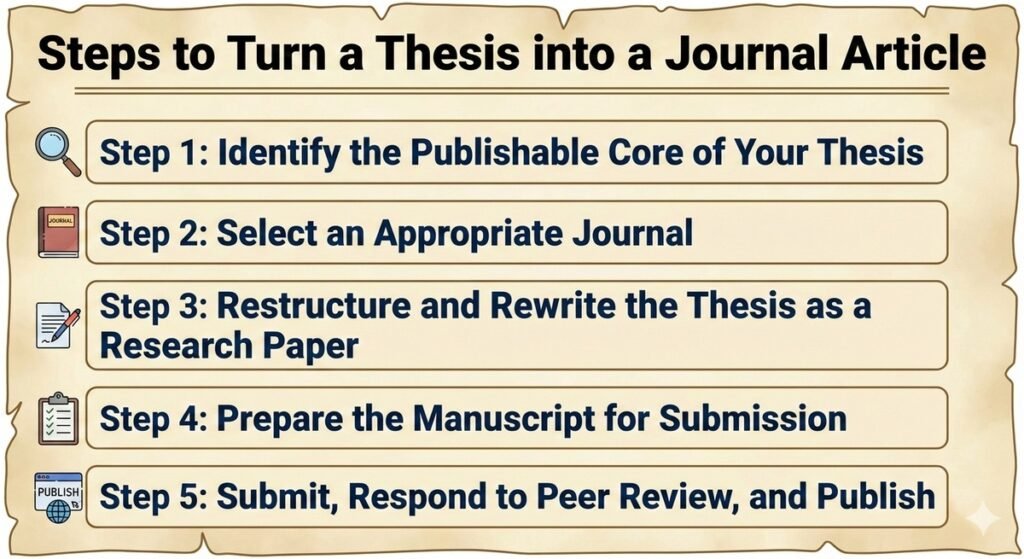
Step 1: Mine Your Thesis for Publishable Gold
Your thesis likely contains enough material for multiple journal articles. The first challenge is identifying which parts deserve publication.
What to Look For
- The most novel finding — What result surprised you or challenges existing knowledge?
- The strongest dataset — Which study yielded the most robust, statistically significant results?
- The most clinically relevant insight — What would practicing physicians find immediately useful?
- The methodological innovation — Did you develop a new technique or approach others should know?
One Thesis, Multiple Papers
Many medical researchers don’t realize that a single thesis can yield:
- One primary research article (your core finding)
- A secondary analysis (exploring a different research question from the same data)
- A methodological paper (describing a novel technique)
- A systematic review (if your thesis included one)
Pro Tip: Discuss with your supervisor which findings have the strongest publication potential. Their experience with journals and reviewers is invaluable at this stage.
Step 2: Find the Perfect Journal Match
Submitting your carefully prepared manuscript to the wrong journal is one of the most common—and avoidable—mistakes in academic publishing.
Your Journal Selection Checklist
| Factor | What to Consider |
|---|---|
| Scope & Aims | Does the journal publish research in your specific medical specialty? |
| Article Types | Does the journal accept the type of article you’re writing (original research, brief report, case study)? |
| Recent Publications | Has the journal published similar studies recently? This suggests interest in your topic. |
| Impact Factor | Is the journal’s prestige appropriate for your work? Be realistic but ambitious. |
| Acceptance Rate | Does the journal have transparent acceptance statistics? |
| Review Timeline | Can you wait 6 months for a decision, or do you need faster publication? |
Red Flags to Avoid
- Unsolicited email invitations to submit (especially from unknown journals)
- Promises of rapid publication with minimal peer review
- Unclear or hidden article processing charges
- Journals not indexed in major databases (PubMed, Scopus, Web of Science)
Step 3: Restructure with Purpose
A thesis and a journal article serve fundamentally different purposes:
| Thesis | Journal Article |
|---|---|
| Demonstrates comprehensive knowledge | Communicates a specific finding |
| Exhaustive literature review | Focused, relevant citations only |
| Detailed methodology for examination | Concise methods for reproducibility |
| All results presented | Only results supporting the core finding |
Key Restructuring Actions
Introduction:
- Start with the broad clinical problem (1-2 paragraphs)
- Narrow to what’s unknown or controversial
- State your research question and hypothesis clearly
- End with what your study contributes
Methods:
- Include enough detail for replication
- Reference your thesis for additional details if needed
- Follow journal-specific reporting guidelines (CONSORT for trials, STROBE for observational studies, etc.)
Results:
- Present findings that directly address your research question
- Use tables and figures strategically—they’re often what readers remember
- Include clear statistical reporting with effect sizes and confidence intervals
Discussion:
- Open with your main finding (1-2 sentences)
- Interpret results in context of existing literature
- Address limitations honestly but briefly
- Close with clinical implications and future directions
Step 4: Polish for Publication Readiness
Before submission, your manuscript must meet professional standards that go beyond basic proofreading.
Essential Preparation Steps
✅ Format to journal specifications — Word limits, reference style, section headings, and file formats vary widely. Follow instructions exactly.
✅ Verify all references — Inaccurate citations suggest sloppy work. Double-check every reference against the original source.
✅ Check for self-plagiarism — Even when writing from your thesis, paraphrase and cite appropriately. Some journals require disclosure that the work is based on a thesis.
✅ Confirm authorship and contributions — Ensure all authors agree on the order and have approved the manuscript. Discuss this early to avoid conflicts later.
✅ Prepare supplementary materials — Some journals allow additional data, figures, or methods to be published online as supplemental content.
✅ Write a compelling cover letter — Briefly summarize your study’s importance, confirm it hasn’t been published elsewhere, and explain why it’s a good fit for the journal.
Step 5: Navigate Peer Review Like a Pro
Peer review can feel intimidating, but it’s a process designed to strengthen your work. Understanding what to expect helps reduce anxiety.
What Happens After Submission
- Editorial triage — The editor decides whether your paper fits the journal and meets basic quality standards (desk rejection is common here—don’t be discouraged).
- Peer review — Experts in your field evaluate your work, typically assessing:
- Originality and significance
- Methodological rigor
- Clarity of presentation
- Ethical compliance
- Editorial decision — You’ll receive one of:
- Accept (rare)
- Minor revisions (good news—you’re nearly there)
- Major revisions (common—address comments thoroughly)
- Reject (disappointing, but not the end)
Responding to Reviewer Comments
| Do | Don’t |
|---|---|
| Respond to every comment respectfully | Argue or become defensive |
| Clearly explain changes made | Ignore difficult questions |
| Quote page and line numbers for revisions | Make changes without explanation |
| Meet the revision deadline | Rush and make careless errors |
| Thank reviewers for their time | Take feedback personally |
If Your Paper Is Rejected
Remember: Rejection is not failure. Some of the most influential medical papers were rejected initially.
- Carefully consider the feedback
- Revise accordingly
- Identify another appropriate journal
- Resubmit with improvements
Persistence is perhaps the most underrated quality in academic publishing.
How MedResearch Supports Your Publication Journey
At MedResearch, we understand that publishing from a thesis involves unique challenges. That’s why we offer specialized support for medical researchers at every stage:
| Service | How We Help |
|---|---|
| Thesis Extraction | We help identify the most publishable elements of your thesis and develop a publication strategy |
| Manuscript Development | Our experienced medical writers transform thesis chapters into focused, journal-ready articles |
| Journal Selection | We recommend target journals based on your research, scope, and publication goals |
| Formatting & Submission | We prepare your manuscript according to journal guidelines and handle the submission process |
| Peer Review Support | We help you interpret reviewer comments and prepare thoughtful, effective responses |
| Ongoing Guidance | From first draft to final acceptance—we’re with you every step of the way |
Ready to Share Your Research with the World?
Your thesis represents valuable knowledge that deserves to be read, cited, and applied. With the right approach and expert support, you can successfully navigate the journey from thesis to publication.
Let MedResearch Central be your partner in this exciting next step of your research career.
📧 Email us: mail2medresearch@gmail.com
🌐 Visit: www.medresearchcentral.com
Your Central Hub for Medical Research — Expert consultancy, scientific writing, and publication support. Guiding researchers from concept to publication, every step of the way.





Leave a Reply